

📖 Muse English چیست؟
Muse English یک اپلیکیشن رایگان آموزش زبان انگلیسی است، با درس روزانه برای هر شش سطح، از A1 (مبتدی) تا C2 (تسلط کامل). هر روز لغتهای تازه با معنی فارسی، یک پادکست واقعی، تمرین شدوئینگ، گرامر و آزمون دارید. دربارهٔ اپ
📚 لغتها
۷ لغت تازه لغتهای تازه با معنی فارسی، مثال واقعی و تلفظ.





پادکست: آموزش و یادگیری
گفتوگوی امروز را گوش کنید.
📝 متن پادکست
Welcome to Muse English! I'm Maya.
And I'm Lena. Today we're diving into something close to our hearts: the science of learning itself.
Right. We spend every episode teaching English words, but today we want to talk about how people actually learn. What makes a great student? What do great teachers do differently?
And we have seven beautiful, very advanced words to explore. Words about education, teaching, and the mind. So if you are ready to think about thinking, stay with us.
Let me start with a story. Two years ago I decided to learn pottery. I had never touched clay in my life. My teacher, Rosa, did something brilliant. On day one, she didn't just hand me clay and say good luck. She shaped the base for me, marked where my hands should go, and guided every movement. Then, week by week, she removed the help. First the marked lines went away. Then the guiding hand stopped. By month three, I was throwing pots alone.
That is a perfect example of scaffolding.
Exactly. Scaffolding is temporary support that helps you do something new, and it gets removed once you can do it alone. Like the scaffolding around a building under construction. It holds everything up, and then it comes down.
I love that image. And scaffolding is everywhere in good teaching. When children learn to write, teachers give them sentence starters. When you learned English, your textbook probably gave you dialogues to copy before asking you to speak freely. That is all scaffolding.
The key idea is that scaffolding is temporary. If the support never comes down, you never learn to stand alone. A good teacher plans the removal of the scaffolding from the very first day.
I think about scaffolding whenever I advise new language learners. I tell them, use the training wheels. Use subtitles, use translation, use example sentences. That is your scaffolding. And then, bravely, take it down piece by piece.
That reminds me of something I learned the hard way in university. I used to reread my notes for hours and feel productive. Then I'd fail the exam and wonder why. A professor finally told me I had zero metacognition.
Metacognition. Awareness and understanding of your own thinking and learning.
Right. I thought I understood the material, but I had never actually tested myself. I had no metacognition at all. I couldn't tell the difference between recognizing a page and truly understanding it.
That is such a common trap. Recognizing feels like knowing, but it is not. Real metacognition means pausing and asking, can I explain this in my own words? Could I answer a hard question about it?
Once I started building metacognition, everything changed. Before an exam I would close the book and try to teach the chapter to an imaginary student. Wherever I got stuck, that was where I needed to study. Metacognition turned my studying from passive to active.
And metacognition matters for our listeners too. When you learn these seven words today, don't just nod along. Test your metacognition. Pause the episode and try to use each word in your own sentence. If you can't, rewind and listen again.
Okay, time for a confession. When I write an essay, I always write the introduction last.
Wait, really? That feels backwards.
It works though. It is a heuristic I picked up in college. A heuristic is a practical rule that helps you find answers quickly, even if it is not perfect. My heuristic says the introduction is easier once you know what you actually argued.
I have heuristics too. When I travel, my heuristic is to learn five phrases before I land: hello, thank you, excuse me, how much, and where is the bathroom. That little heuristic has saved me in twelve countries.
That is the beauty of a heuristic. It is not a law of physics. Sometimes the heuristic fails. But a good heuristic gets you moving fast, and you can refine it later. Another heuristic I love for language learning: learn the most common thousand words first. It is not perfect, but as a heuristic it covers most daily conversation.
Quick pause, friends. If you are enjoying this episode, you will love the Muse English app. Every day you get new words with real photos and pronunciation audio, this exact podcast, shadowing stories where you speak along with a tutor, fun quizzes, and grammar lessons that build week by week. There is even a leaderboard where you earn points for finishing lessons. It is free to install, and it turns ten spare minutes a day into real progress. Search for Muse English and start today.
Now let's talk about something close to my heart, because I teach weekend English classes for adults. Have you heard of andragogy?
The methods used in teaching adults, right? As opposed to teaching children.
Exactly. Andragogy is built on one big insight: adults learn differently from kids. Children accept what the teacher says. Adults need to know why. If I tell my adult students, memorize this grammar rule, they resist. But if I connect it to their work, their travel, their lives, andragogy tells me they will learn it ten times faster.
That makes so much sense. In andragogy, the student's experience is the textbook. A forty-year-old engineer learning English already knows how the world works. You don't teach her like a child. You build on what she brings.
Researchers of andragogy found something beautiful too. Adults are most motivated when learning solves an immediate problem. So my weekend classes are built around real situations: a job interview on Monday, a presentation on Friday. That is andragogy in action.
I want to honor the quiet heroes of learning now. Picture this. Midnight. A small desk. One lamp. A student surrounded by books, writing slowly, thinking deeply. There is a gorgeous word for that kind of work: lucubration.
Lucubration. Studious work, especially late at night. I love how it sounds like what it means.
My master's thesis was pure lucubration. For six months, after my day job, I sat at my kitchen table until one in the morning, reading and writing. Nobody saw it. There was no applause. Just quiet, laborious lucubration.
There is something sacred about lucubration, isn't there? The world is asleep, the phone is silent, and it is just you and the ideas. Deep learning rarely happens in noise. It happens in lucubration.
But here is the catch. Lucubration only works with rest. I learned that the hard way. Three nights of lucubration with no sleep, and on night four my brain simply refused. Real lucubration is a rhythm: deep work, then real rest.
And here is a little secret about learning faster. The Muse English app was built for exactly this kind of deep practice. You get daily vocabulary with photos that make words stick, pronunciation you can copy, shadowing stories that train your mouth and your memory, short quizzes that test what you learned, and clear grammar lessons. Plus points and a leaderboard that keep you coming back. Download it free, open today's lesson, and feel the difference within a week. Your future fluent self says thanks.
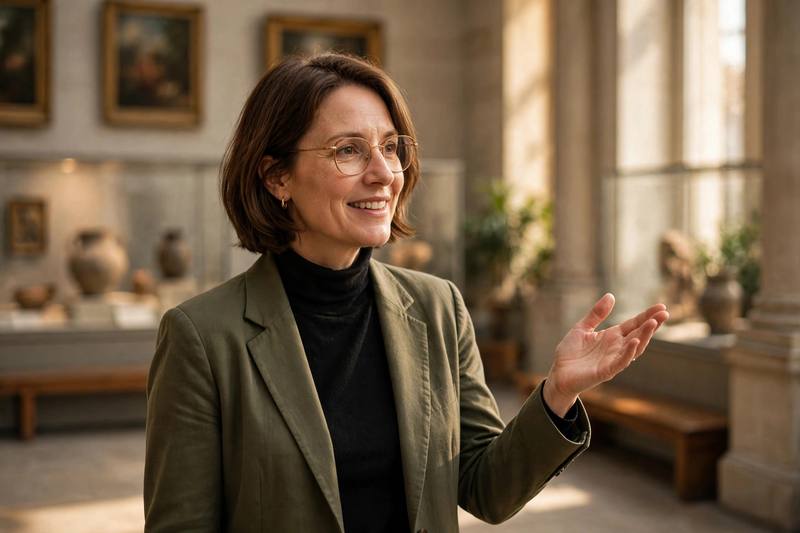
Let me take you to the best classroom I have ever been in. It wasn't a classroom at all. It was the modern art museum downtown. Our guide was a retired professor, and within five minutes, twenty strangers were hanging on his every word.
He sounds like a wonderful docent.
A docent is a teacher or guide, especially one who lectures at a museum or university. And this docent was a master. He didn't list dates and names. He told us that the painter had just lost his wife, and suddenly the blue in the painting meant something.
That is what a great docent does. A docent turns looking into understanding. I think every subject needs its docents. The world is full of museums, libraries, and ideas, but without a good docent, we walk past them blind.
I still remember that docent's final line. He said, art is not about seeing more. It is about seeing deeper. I think about that every week.
Alright, I have to ask. Our last word today is a little bit of a joke and a little bit of a warning: sesquipedalian.
Meaning fond of very long words. Or just long-winded.
I once had a professor who spoke only in sesquipedalian sentences. He could have said, this policy helps poor families. Instead he said, this fiscal intervention ameliorates socioeconomic precarity among marginalized demographics. Pure sesquipedalian fog.
Oh, I know that type. Sesquipedalian language is often a hiding place. When someone doesn't fully understand an idea, sesquipedalian words can mask the confusion.
But here is the twist for advanced learners. At C two level, you need to survive sesquipedalian texts. Academic papers, legal documents, they are full of sesquipedalian vocabulary. Your job is not to write that way. Your job is to decode it, and then say it simply.
Beautifully put. Learn the sesquipedalian words so nobody can confuse you, then choose clarity anyway.
Let's bring it all together. Seven words, one story about learning. Start with scaffolding: accept help, use support, then remove it bravely. Build metacognition: test yourself honestly, and study what you cannot explain. Use heuristics: practical shortcuts that get you moving, like writing the introduction last.
Remember andragogy: as an adult, connect every lesson to your real life. Honor lucubration: protect quiet hours for deep work, and rest too. Learn from every great docent you meet, in museums and in life. And when you face sesquipedalian fog, decode it, then choose simple words.
That is the science of learning, in seven words. Try using all seven this week. Write them in sentences. Say them out loud. And tell us which one was your favorite.
Thanks for learning with us on Muse English. Keep practicing, keep questioning, and we will see you tomorrow.
Bye everyone!
🎙 تمرین شدوئینگ نمونهٔ رایگان
گوش کنید و همزمان با صدا بلند تکرار کنید. تمرین کامل شدوئینگ در اپ است: هر جمله را تکرار میکنید و میبینید اپ چند کلمه از آن را تشخیص داده است.
The Night School
Sara signed up for night classes because she wanted to become a better writer.
On the first evening, the teacher gave everyone strong scaffolding for the first essay.
صحبت کردن را تمرین کنید
در اپ Muse English همهٔ جملهها را شدوئینگ کنید. اپ گوش میدهد و نشان میدهد چند کلمه از جملهتان را تشخیص داده است.
📝گرامر: Cleft Sentences and Emphatic Do
Cleft sentences let you put the spotlight on one part of a sentence. Instead of saying everything flatly, you split the sentence to emphasize what matters most.
There are two main cleft types. It-clefts start with it was or it is: It was Rosa who taught me pottery. The plain version would be: Rosa taught me pottery.
Wh-clefts start with what: What I needed was more lucubration. Here the emphasis falls on the thing you needed, placed at the end for weight.
Emphatic do works differently. You add do, does, or did before the main verb to stress truth
این گرامر را در اپ کامل یاد بگیرید
توضیح کاملتر، مثالهای بیشتر و تمرین تعاملی.
راهنمای کامل و تمرینها: Cleft Sentences (It was... that, What I need is...) ←
هر روز ادامه بدهید
هر روز درس، پادکست و آزمون تازه؛ رایگان در اپ Muse English.