

📖 What is Muse English?
Muse English is a free English learning app with daily lessons across all 6 CEFR levels (A1 Beginner to C2 Proficient). Every day brings new vocabulary, a real podcast conversation, shadowing practice, grammar and quizzes — all at museenglishapp.com.
📚 Vocabulary
10 new words Learn new words with real examples and audio.



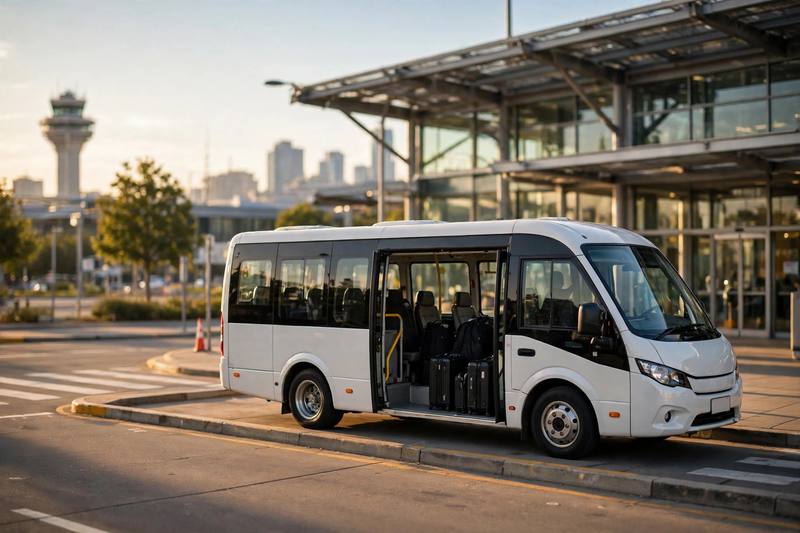

Podcast: Travel & Transport
Listen to today’s conversation.
📝 Podcast Transcript
Welcome back to Word Kitchen! Today we're talking about traveling smart — getting through airports and train stations without stress.
Great topic, Maya. I love traveling, but the airport part always makes me nervous.
Totally understandable. Airports are full of announcements, long lines, and signs in a foreign language. But a few key words make everything much easier.
Me too, until I learned some smart travel words. Let's start with itinerary. Your itinerary is your detailed travel plan — the list of places you will visit, and when.
So like, my itinerary for next month is Rome, then Florence, then Venice?
Exactly. I always print my itinerary before a big trip. Actually, do you share your itinerary with your family?
Yes! I send my whole itinerary to my mom so she knows where I am. Having a clear itinerary makes the trip feel real.
A good itinerary also saves money. If your itinerary is planned in advance, you don't waste time deciding every morning.
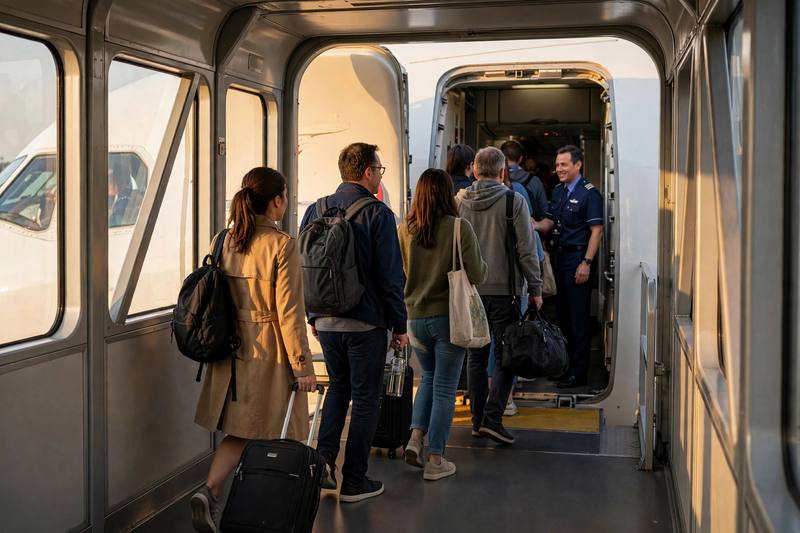
Okay, next word: boarding. That's when passengers get on the plane, right?
Right. Boarding usually starts about forty minutes before the flight. When they call your group, you show your ticket and walk onto the plane.
I always arrive early because I hate rushing during boarding. Last time, the boarding was delayed and everyone stood in line forever.
Oh, that's annoying. I like to wait in my seat until the final boarding call. Then there's no long line.
Smart. What about platform? That one is for trains.
Yes. The platform is the raised area next to the track where you get on the train. You check the departure screen to find your platform number.
Like platform nine at a big station?
Exactly. I once ran to the wrong platform and almost missed my train. Always double-check the platform on the screen.
Good advice. And when you change trains, that's a transfer.
A transfer is when you change from one vehicle to another during your trip. For example, you might take a bus and then transfer to the metro.
In London I had a transfer from the train to the underground. The signs for the transfer were really clear.
Some transfers are tight. My last transfer gave me only ten minutes, and I had to run!
Stressful. Speaking of seats — aisle or window?
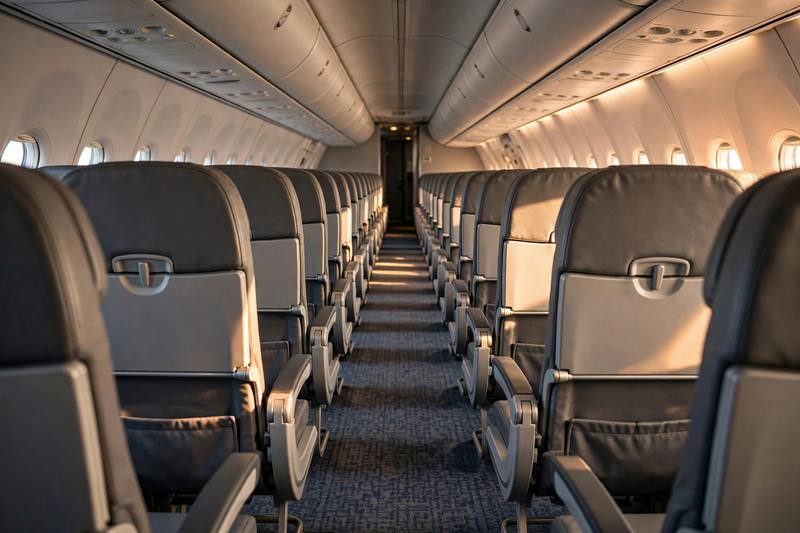
I'm team aisle. The aisle is the long passage between the rows of seats. An aisle seat means you can stand up easily.
I love the window, but on a long flight the aisle is better. Last time I sat in the middle and climbed over two people every hour. Never again.
Ha! With an aisle seat you control your own space. The flight attendant walks down the aisle with the drink cart, so you get served first too.
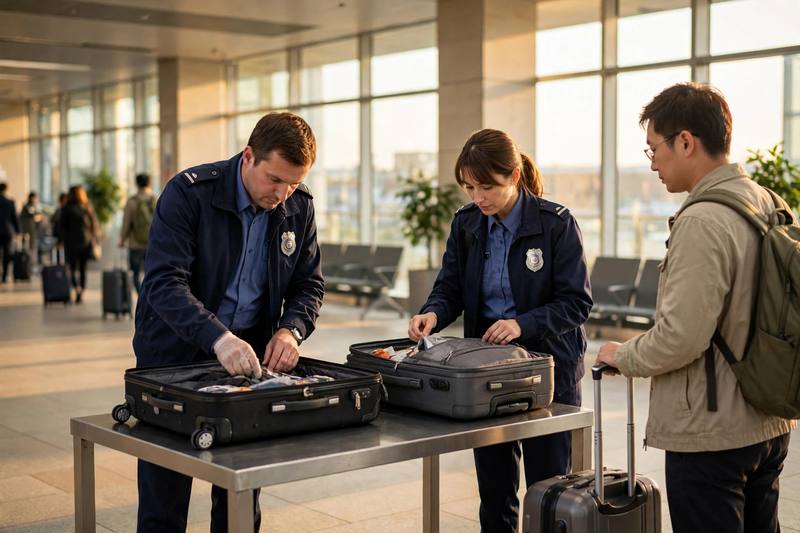
True. Now customs — the place at the airport where officers check your bags?
Yes. After you land in a new country, you go through customs. Officers may ask what you bought abroad or look inside your bags.
The line at customs can be so long. Once I waited at customs for almost an hour in New York.
Same. Pro tip: have your passport ready before you reach customs. It speeds everything up.
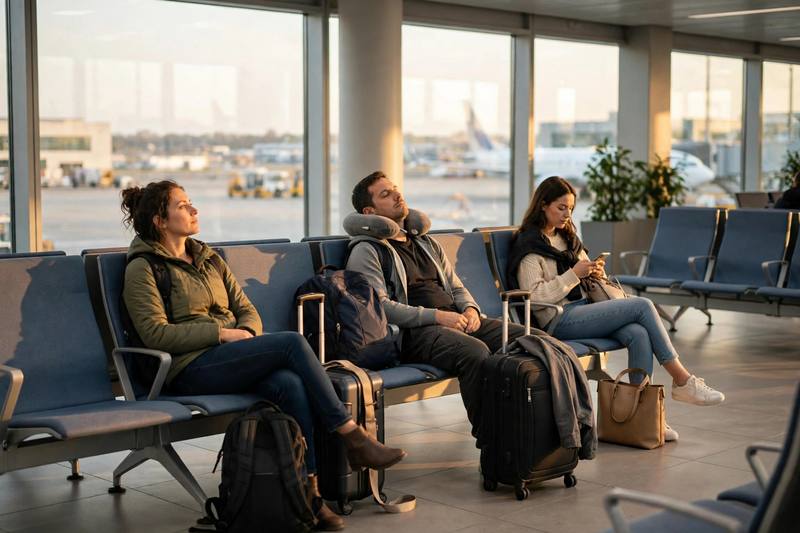
What about layover? That's a short stop between connecting flights.
Right. A layover is the waiting time between your first flight and your next one. A two-hour layover is perfect — enough time to relax, not enough to get bored.
My favorite layover was in Istanbul — five hours, so I explored the airport food court. But a twelve-hour layover? That's too much.
For a long layover, some airports let you leave and see the city. Always check the rules before a long layover.
Before we move on, what's the difference between a layover and a connection? They sound similar.
Good question. A connection is the flight itself — the plane that takes you onward. A layover is the waiting time between the two flights.
So the layover is the boring part, and the connection is the next flight. Got it.
Exactly. And if your layover is long enough, you can sometimes turn it into a mini adventure in a new city.
Carry-on — the small bag you take onto the plane.
Yes! A carry-on is the bag you keep with you instead of checking it in. I travel with only a carry-on, so I never wait at baggage claim.
Same here. Packing a small carry-on forces you to pack light. My carry-on has everything for a whole week.
And a good carry-on fits in the overhead bin. If your carry-on is too big, they make you check it.
Shuttle — like the airport bus?
A shuttle is a bus or small plane that travels regularly between two places. The airport shuttle runs every twenty minutes between the airport and the city center.
Hotels often have a free shuttle too. When I land late, I take the hotel shuttle instead of an expensive taxi.
Smart. Some shuttles need booking in advance, so check the shuttle schedule before your trip.
Last one: connection. That's the next flight that continues your journey, right?
Exactly. If you fly from Tehran to Paris with a stop in Istanbul, the Istanbul flight is your connection. Miss your connection and you wait for the next one.
I once missed a connection because my first flight was late. Now I always choose a connection with at least two hours between flights.
Good rule. A tight connection is exciting only in movies. A comfortable connection means coffee, not running.
Let's review all ten: itinerary, boarding, platform, transfer, aisle, customs, layover, carry-on, shuttle, connection.
Quick challenge, Lena. I'll describe a situation, and you name the word. You're at the airport and they call your group to get on the plane.
Boarding!
You change from a bus to a train downtown.
A transfer!
The detailed plan of your whole trip.
Itinerary.
The small bag you keep with you on the plane.
Carry-on.
You're an expert traveler now. Try using all ten words this week — plan your itinerary, arrive early for boarding, and always give yourself a comfortable connection. See you next time on Word Kitchen!
🎙 Try Shadowing free sample
Listen and repeat along with the studio audio. Full shadowing practice with pronunciation scoring is in the app.
A Smooth Trip to Rome
I planned my itinerary carefully before the big trip
My itinerary included two flights, so I packed one small carry-on
Train your speaking
Shadow every sentence with studio audio and get your pronunciation scored — only in the Muse English app.
📝Grammar: Present perfect and past simple
The **present perfect** is **have** or **has** + the **past participle**. Use it for past experiences when you don't say when, like a strange customs check or a long layover. Also use it for recent actions with a present result, often with **just**, **already**, or **yet**. Our boarding has just started, so the aisle is still empty. The **past simple** is for finished actions when we say, ask, or know when they happened. We missed our connection last Friday because the shuttle was late. Use **ever** and **never** with the present perfect to ask about life experiences: a crazy transfer, a wr
Master this grammar in the app
Get clear explanations, more examples and interactive exercises.
Keep learning every day
New lessons, podcasts and quizzes daily — free in the Muse English app.